About VidoSave
VidoSave is a browser-based tool for processing supported public video links and showing the media formats that are currently available for a submitted URL. The basic workflow does not require account registration, and the service is built around clarity, transparency and responsible media use.
A focused tool for supported public links
VidoSave was created around a straightforward idea: when a user submits a supported public video URL, the service should identify the source, return the media information that is currently exposed for that link, and present the available formats in a clear browser interface.
The service is intentionally link-based. It is not a social network, a public media library or an upload platform. VidoSave does not ask users to create an account for the basic link-processing workflow, and it does not ask for a platform password in order to process a normal public link.
Availability is not guaranteed for every URL. A source platform may change its technical response, remove a file, expire a media address, limit access or expose different formats at different times. VidoSave therefore displays the formats that are actually returned for the submitted link instead of promising a fixed quality that may not exist.
Public-link workflow
The tool is designed around supported public URLs rather than private-account access.
Dynamic formats
Results reflect the media options returned for that specific link at that time.
Browser based
The basic workflow runs from the browser without a required VidoSave account.
No public media library
VidoSave does not publish a searchable library of copies submitted by its users.
Useful technology should come with clear boundaries
VidoSave is designed to make the workflow understandable without presenting every publicly reachable media file as automatically free to copy or reuse. Copyright, permission and provider rules still matter.
Responsible use
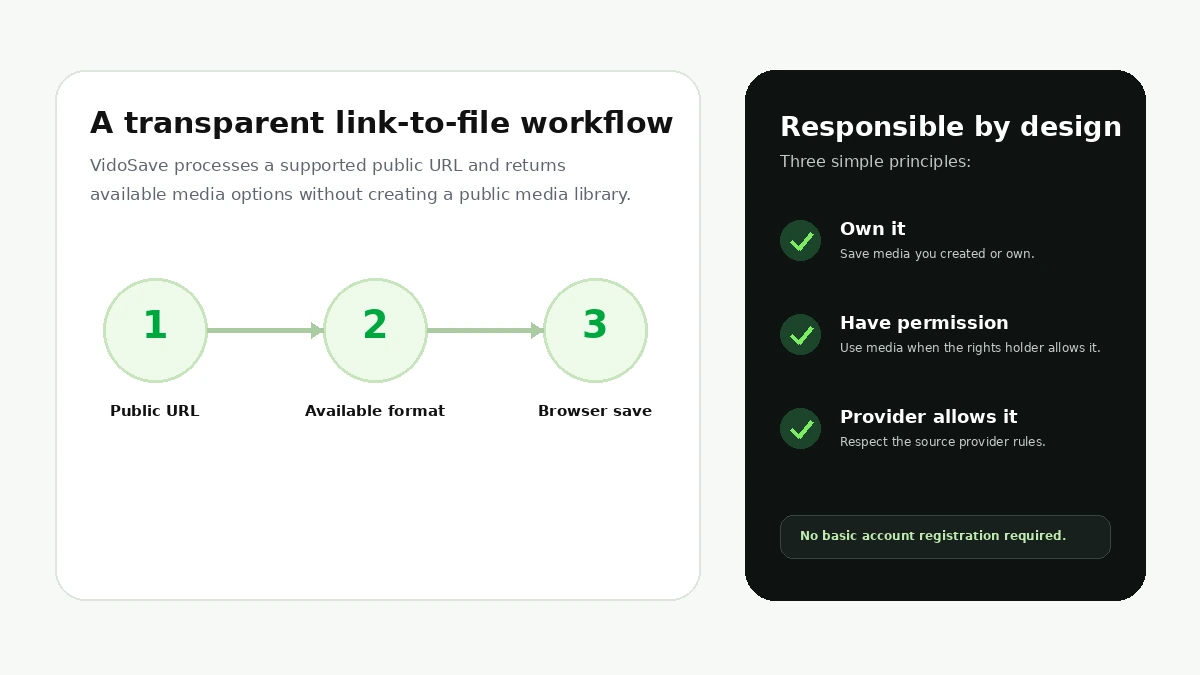
Use the service only for media you own, have permission to save, or that the content provider expressly permits you to download.
Transparency
Supported formats and availability can vary by source, link and time. We prefer to explain those limits rather than make unrealistic promises.
Privacy-aware workflow
The basic VidoSave tool does not require users to create a VidoSave account before submitting a supported public link.
From a submitted link to an available media option
A submitted URL is processed to identify the source and the media information available for that public link. When a usable media option is returned, VidoSave presents it to the user and the browser can then open or save the selected file, depending on the source response and browser behavior.
VidoSave does not operate a public archive of downloaded videos. The service is built as a processing and transfer layer, not as a destination where submitted media is published for other visitors to browse.
Technical availability does not itself establish ownership or permission. Users should verify that saving the media is allowed by the rights holder and by the applicable source or content-provider rules.
Clear expectations are part of the product
VidoSave does not claim that every platform, every video or every quality will always be available. A public page may still have restrictions imposed by the source, the creator, local law, copyright rules or technical access controls.
VidoSave also does not present private-account access, password collection or the circumvention of access controls as features of the service. If a source does not make a usable media option available to the current workflow, the correct result may simply be that the link cannot be processed.
Policies that explain how VidoSave should be used
We want important rules to be easy to find rather than hidden inside the interface. These pages explain the current terms, privacy practices and how to contact the site.
About VidoSave FAQ
Is VidoSave a video hosting website?
No. VidoSave is built around processing supported public links and returning available media options. It does not operate a public library where users upload and publish videos for other visitors.
Does VidoSave require an account?
The basic public-link workflow does not require a VidoSave account or registration.
Does a public video automatically mean it may be downloaded and reused?
No. Public visibility does not automatically grant copyright, download or reuse permission. Users should rely on their own rights, permission from the rights holder, or an express download permission from the content provider.
Why can availability change?
Media URLs, formats and provider responses can change or expire. VidoSave therefore reports what is actually available for the submitted link rather than promising permanent access to a particular file or quality.
A simple tool, with responsible use at the center
VidoSave aims to keep public-link processing straightforward while being clear about technical limits, copyright and user responsibility.